
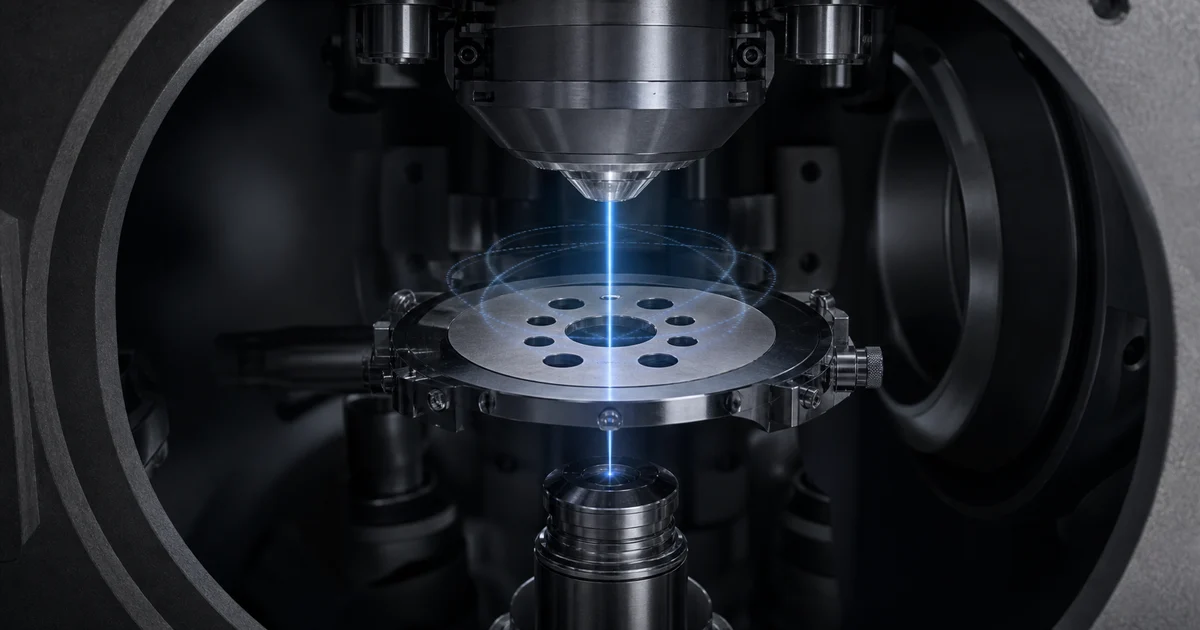
What the aperture does
The objective aperture in an SEM column is a small physical hole that the electron beam passes through on its way to the sample. Typical aperture diameters range from a few micrometers to a hundred micrometers, with the exact choice depending on the imaging mode (smaller aperture = better resolution but less beam current; larger aperture = more current but more spherical aberration).
The aperture serves several purposes:
Limits the beam divergence: only the central, on-axis portion of the beam from the source passes through. This reduces spherical aberration (off-axis rays from the source bend more in the lenses than on-axis rays).
Defines numerical aperture: the aperture diameter and its position relative to the final focusing lens together set the numerical aperture (NA) of the beam, which influences the diffraction-limited resolution and depth of field.
Filters out high-energy outliers: in some configurations, contributes to chromatic-aberration control.
The aperture's effectiveness depends on its alignment to the electron-optical axis of the column. If the aperture isn't centered on the axis, only the off-center part of the beam can pass through — degrading performance in multiple ways.
What "alignment" means
The electron-optical axis of an SEM column is the imaginary line that, in an ideal column, the central electron beam would travel along. In practice, the actual axis is defined by the geometry of the gun, the condenser lens(es), the objective lens, and any deflection or correction systems.
The objective aperture is mounted in a holder that can be physically moved (with micrometer screws) and electrically deflected (via alignment coils) to center it on this axis.
A well-aligned aperture:
- Passes the center of the beam.
- Allows full performance of the objective lens.
- Produces stationary images during focus changes.
- Allows astigmatism correction in all directions equally.
A misaligned aperture:
- Passes an off-axis portion of the beam.
- Introduces effective "tilt" of the beam relative to the optical axis.
- Causes image shift with focus or magnification changes.
- Reduces achievable resolution.
The wobble test: standard alignment verification
The single most-used SEM column alignment test is the wobbler: a built-in function that briefly oscillates the objective lens current at a low frequency (typically 1-5 Hz). The oscillation alternates between slight under-focus and slight over-focus.
Well-aligned aperture: the image breathes — features appear slightly blurry then sharp then blurry again as the focus oscillates, but they don't translate. The image pulses but stays still.
Misaligned aperture: in addition to the focus pulsing, the image translates laterally during the wobble — features oscillate back and forth in a specific direction. The magnitude and direction of the translation indicate the magnitude and direction of misalignment.
The physics: when the aperture is off-axis, the off-axis portion of the beam passing through it has a different "effective angle" to the lens than the central beam would. Changing the lens current then changes the image position (not just the focus), producing the visible translation.
The standard procedure
A routine aperture alignment workflow:
Bring a sample into focus at moderate magnification (say 10,000x). A featureful sample helps — pure flat surfaces don't give clear visual alignment cues.
Activate the wobbler. Modern SEMs have a software button or hardware switch.
Observe the image:
- Focus breathing only? → aperture is well aligned.
- Image translates left/right or up/down? → aperture is misaligned in that direction.
Adjust alignment: using the SEM's aperture alignment control (typically X and Y deflection in software), adjust in the direction OPPOSITE the observed image translation. The image translation magnitude should decrease as you approach alignment.
Iterate: continue adjusting until the wobble shows only focus breathing with minimal lateral motion. Achievable to within a small fraction of the original misalignment.
Deactivate wobbler: turn off the oscillation.
Re-focus and re-stigmate: with the aperture aligned, optimal imaging conditions may have shifted slightly.
Verify: at the actual imaging magnification, the image should now be sharp, with no lateral drift on focus changes, and astigmatism corrections symmetric.
Mechanical vs electronic alignment
Two layers of alignment exist:
Mechanical alignment: physical positioning of the aperture using micrometer screws on the aperture holder. Required when:
- An aperture is replaced (apertures wear and eventually need swapping).
- The column has been opened (e.g., for service).
- Mechanical drift has accumulated over time (rare).
Mechanical alignment is more involved — typically requires the column to be in a known state, may need a special setup, and is documented in instrument-specific procedures.
Electronic alignment: software-controlled deflection coils steer the beam to pass through the aperture center. Used for:
- Routine fine alignment during regular operations.
- Quick adjustment between samples.
- Daily/weekly alignment checks.
Electronic alignment is fast, repeatable, and the default for routine use. Most operators only do mechanical alignment after maintenance events; otherwise everything is electronic.
When to align
Frequency depends on use case:
Before any high-resolution imaging session: 10-30 seconds with the wobbler is cheap insurance.
Before quantitative measurements: especially for metrology-grade work.
After any sample chamber opening: thermal and mechanical disturbances can shift alignment.
Weekly: routine check for active-use labs.
Monthly: minimum for less-frequently-used instruments.
Mechanical: only when needed (aperture change, service event).
Symptoms of misalignment
Several telltales suggest aperture alignment problems:
Resolution lower than expected: ratios of 1.5x-3x worse than spec at the same magnification could indicate aperture misalignment.
Image translation during focus: the most direct symptom. Adjusting focus shifts the image left/right or up/down.
Asymmetric astigmatism: correcting astigmatism in one direction worsens it in another. The stigmator can't reach an optimal setting.
Image shift with magnification change: a well-aligned column produces same-centered images at different magnifications. Aperture misalignment introduces magnification-dependent image shift.
Lower beam current than expected: less of the beam passes through the misaligned aperture, reducing signal.
Sensitivity to accelerating voltage: alignment that's correct at one voltage may be off at another if the misalignment is significant.
Gun alignment
A related procedure: gun alignment. The electron gun (source) needs to be aligned so the beam enters the condenser-lens system on-axis. Misalignment shifts the beam off-axis at the source, producing similar symptoms to aperture misalignment but with a different physical origin.
Modern SEMs with automated alignment combine gun and aperture alignment into a single workflow. Older instruments require separate manual procedures.
The wobble test combined with proper diagnostic interpretation can distinguish gun misalignment from aperture misalignment: gun misalignment typically produces image translation that's the same direction regardless of focus polarity, while aperture misalignment produces translation that changes direction with focus polarity.
A note on aperture wear
Apertures wear over time:
- Charging: insulating contamination on the aperture can charge under the beam, deflecting the beam unpredictably.
- Physical erosion: prolonged beam exposure erodes the aperture hole slightly, changing its size and shape.
- Contamination buildup: hydrocarbon contamination on aperture surfaces accumulates from outgassing in the column.
Regular aperture cleaning (or replacement) is part of column maintenance. Cleaning usually involves the aperture being removed and treated with a controlled cleaning procedure (manufacturer-specific). Replacement intervals depend on use:
- Light use: yearly.
- Heavy use: monthly to quarterly.
- Heavy contamination conditions: more often.
Tying it to the physics
For readers wanting the foundational concepts behind this:
- Aperture and numerical aperture are explained in plain English in Feynmanpedia's how lenses actually work and how microscopes work.
- Aberrations that misaligned apertures emphasize are covered in how optics actually works.
For SEM-specific operational concerns, see semsip's existing coverage of astigmatism correction and focus/stigmation workflow.
The takeaway
The objective aperture in an SEM column must be centered on the electron-optical axis for best performance. The standard verification is the wobble test: rapidly oscillating the objective lens current and observing whether the image stays still (aligned) or translates (misaligned). Adjustment is done with electronic deflection coils for routine alignment, or with mechanical micrometer screws for setup after maintenance. Aperture misalignment causes resolution degradation, image translation during focus changes, asymmetric astigmatism behavior, and other symptoms. Routine alignment frequency depends on use case: before each high-resolution session for serious work, weekly to monthly for general operation. The optics physics underlying this is the same as any focused beam — covered in plain English in Feynmanpedia's optics-explained cluster.